





Beating on the B
Posted by lex, on July 17th, 2011
The Economist takes a dismal view of Lockheed Martin’s F-35 program:
The latest cost estimates from the Government Accountability Office (GAO), published in May to coincide with a Senate Armed Services Committee hearing on the F-35 programme, were shocking. The average price of each plane in “then-year” dollars had risen from $69m in 2001 to $133m today. Adding in $56.4 billion of development costs, the price rises from $81m to $156m. The GAO report concluded that since 2007 development costs had risen by 26% and the timetable had slipped by five years. Mr Gates’s 2010 restructuring helped. But still, “after more than nine years in development and four in production, the JSF programme has not fully demonstrated that the aircraft design is stable, manufacturing processes are mature and the system is reliable”. Apart from the STOVL version’s problems, the biggest issue was integrating and testing the software that runs the aircraft’s electronics and sensors. At the hearing, Senator John McCain described it as “a train wreck” and accused Lockheed Martin of doing “an abysmal job”…
The bipartisan fiscal responsibility and reform commission appointed by Mr Obama last year said that not all military aircraft need to be stealthy. It suggested cancelling the STOVL version of the F-35 and cutting the rest of its order by half, while buying cheaper F-16s and F-18s to keep numbers up. If America decided it could live with such a “high-low” mix, foreign customers might follow suit.
The danger for Lockheed Martin is that if orders start to tumble, the F-35 could go into a death spiral. The fewer planes governments order, the more each one will cost and the less attractive the F-35 will be. This happened to the even more sophisticated and expensive F-22. By cutting its order from 750 to 183, the Pentagon helped to drive the programme cost per aircraft of the F-22 up from $149m to $342m.
In a separate article in the same magazine, the STOVL variant takes particularly sharp hits:
The radical answer would be to abandon the entire F-35 programme. But it is too late for that: it would mean America relying on updated versions of aircraft based on 40-year-old designs. However, the size of the planned order for what is almost certain to be America’s last manned strike fighter makes little sense and should be cut. One immediate priority should be cancelling the jump-jet variant of the F-35 for the Marines. It has been the main cause of the technical and weight problems that have bedevilled the programme. Having been put on two-year “probation” by Mr Gates in January, this version should be put out of its misery.
The good news, if any is to be found, is that China’s new J-15 naval fighter isn’t all that and a bag of chips, according to defense analyst David Axe, writing in The Diplomat:
If Shi Lang is meant to operate in a sea control role, clearing the ocean of enemy vessels, then it could find itself at a disadvantage compared to rival naval forces. The C-602 has a range of around 250 miles. So a Chinese carrier battle group could strike surface targets at a distance of 500 miles.
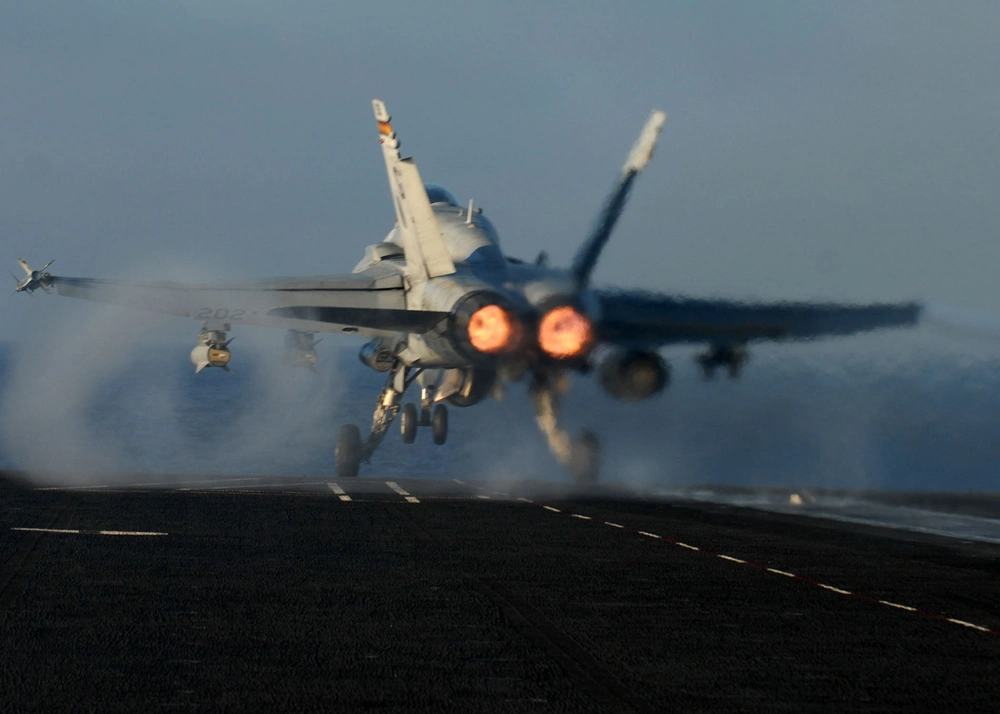
A US carrier group launching F-18s armed with Harpoon anti-ship missiles could strike from a distance of at least 600 miles. Factor in aerial refueling – and the fact that the Harpoon is light enough for a single F-18 to carry two – and the US advantage increases dramatically. The Su-33 is simply not an ideal fighter for ramp-equipped carriers.
It’s telling that within a few years, the Chinese will be the only country operating Su-33s or its derivatives from carriers. The Russians decided to replace the Su-33 with a version of the much smaller MiG-29 after realizing that the MiG had similar performance, but Kuznetsov could carry many more of them. The Indians, too, are buying a MiG-29 variant to replace their Harriers.
Future Chinese carriers could include a catapult. Indeed, the likelihood that carriers after Shi Lang will be catapult-equipped is sure to increase, once the PLAN sees firsthand how limited its J-15s really are.
That buys us another 10-15 years, maybe.